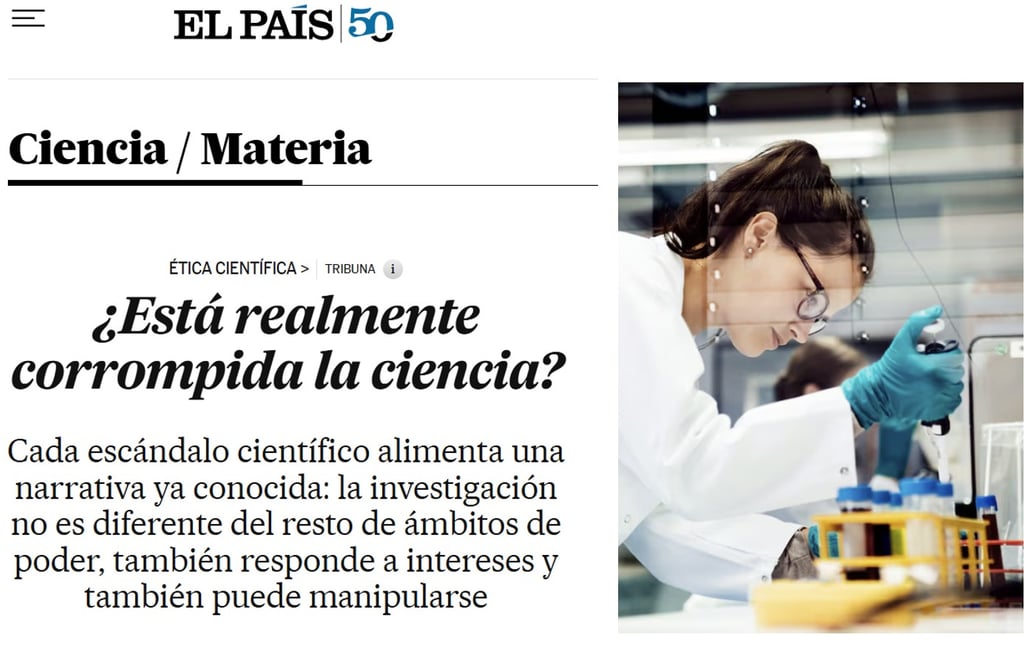
25th March 2026 - Opinion piece in the top Spain's newspaper EL PAIS
Defending the Scientific Method - Prof Jorge Rodríguez's
This week, the Spanish newspaper El País —the country’s leading national daily— features, in its Science section, an opinion piece by Prof Rodríguez reflecting on a growing societal concern: the perception that science itself is becoming corrupted. The article argues for a crucial distinction between individual failures within the scientific enterprise and the robustness of the scientific method as a system of knowledge production. Despite its imperfections and institutional challenges, science remains uniquely structured around critical scrutiny, reproducibility, and long-term self-correction. In this context, the piece offers a defense of the scientific method as one of the few frameworks capable of sustaining reliable knowledge in an increasingly distrustful world.
Original (in Spanish): https://elpais.com/ciencia/2026-03-25/esta-realmente-corrompida-la-ciencia.html
English translated: https://www.linkedin.com/pulse/science-truly-corrupt-jorge-rodr%C3%ADguez-r--nc4hf/
Prof Jorge Rodríguez's interview for KU Pulse, Khalifa University's Podcast and YouTube
In this interview Jorge explains how microbes work to clean wastewater, while producing renewable biogas, biodegradable plastics, fertilizers and industrial chemicals. The conversation explores the role of environmental biotechnology in supporting circular economy models, advancing food security, and contributing to the United Nations Sustainable Development Goals related to water and sanitation and climate action.
Also in Spotify (https://open.spotify.com/episode/61MJDVV6qRs3wYCt2cWddI?si=ba63391efdc64a5f)

MEDIA COVERAGE OF OUR WORK ON EPIDEMIOLOGY MODELLING DURING THE COVID19 PANDEMIC
19th October 2021 - Abu Dhabi Department of Health News
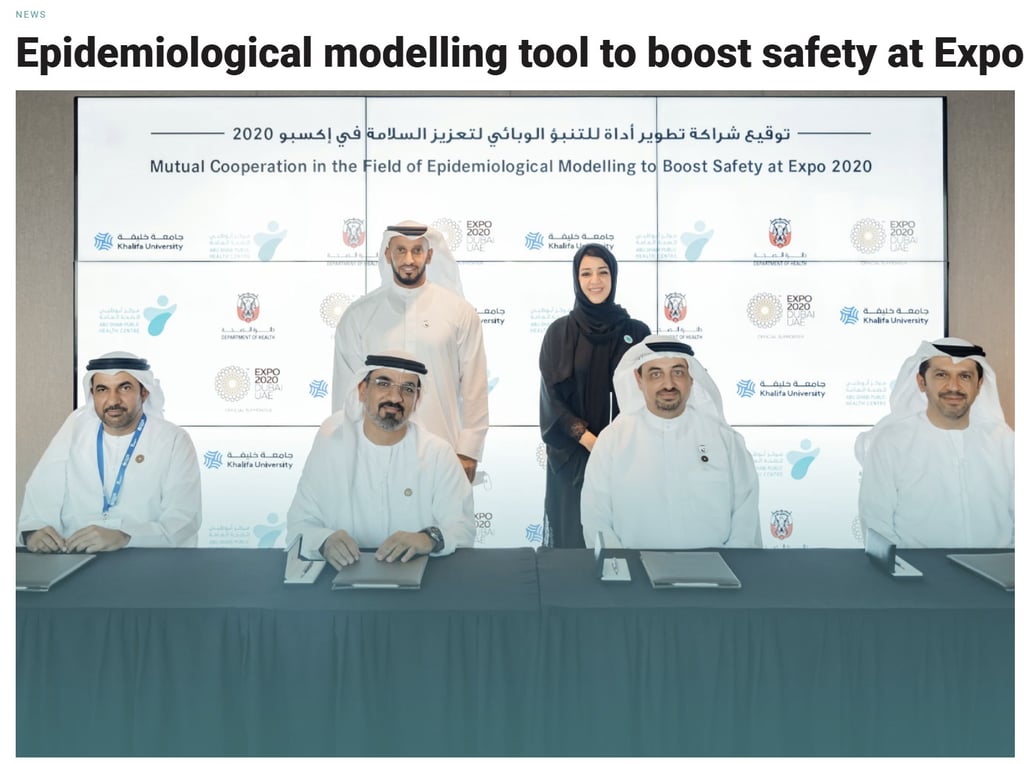
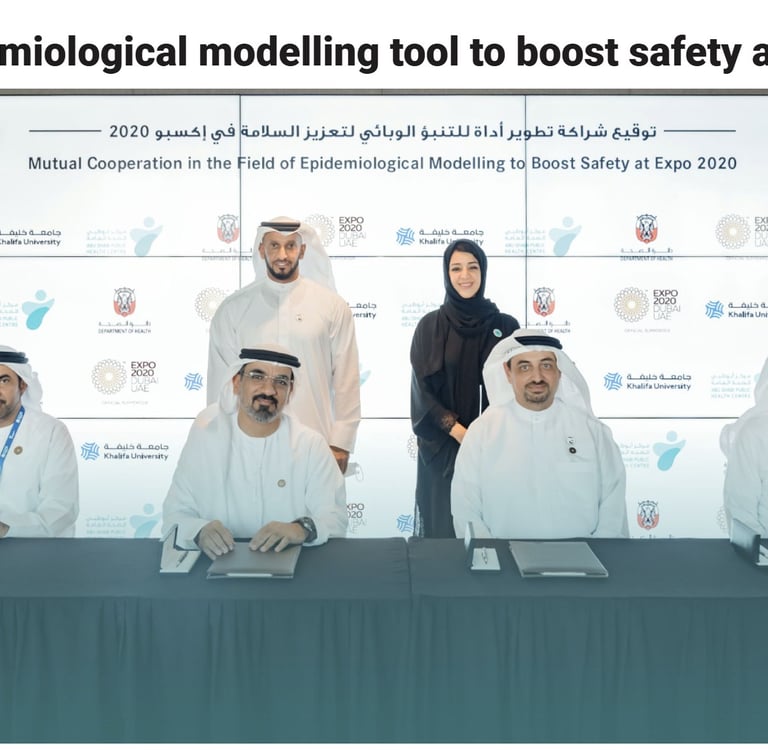
Epidemiological modelling tool to boost safety at Expo 2020
Department of Health – Abu Dhabi (DoH), the regulator of the healthcare sector in the emirate, announced today the development and deployment of a pioneering epidemiological modelling tool to be used during Expo 2020 Dubai. The announcement was made during a ceremony held at Expo 2020, where the department gathered a number of strategic partners including Expo 2020, the Abu Dhabi Public Health Centre (ADPHC) and Khalifa University of Science and Technology (KU).
UAE media coverage of our Epidemiology Modelling work during the COVID19 pandemic
Seleted media elements


International media coverage of our work during the COVID19 pandemic
Selected media elements
19th October 2021 - Abu Dhabi Department of Health News
Epidemiological modelling tool to boost safety at Expo 2020
Department of Health – Abu Dhabi (DoH), the regulator of the healthcare sector in the emirate, announced today the development and deployment of a pioneering epidemiological modelling tool to be used during Expo 2020 Dubai. The announcement was made during a ceremony held at Expo 2020, where the department gathered a number of strategic partners including Expo 2020, the Abu Dhabi Public Health Centre (ADPHC) and Khalifa University of Science and Technology (KU).


April 2020 - Khalifa University's Live Virtual Lecture on Covid-19 with Dr. Jorge Rodriguez
How mathematical models can help us understand and decide on interventions against COVID19
KU researchers developed a mathematical model to help policymakers and non-experts around the world tackle COVID-19 challenges. The model assists in societal and healthcare planning, and forecasting of resource needs at times of pandemics. The model takes into account that countries respond to the COVID-19 pandemic with varying intensity, depending on their access to technology, as well as the availability of resources and manpower. This could range from universal social isolation to selective isolation of the elderly and other measures.

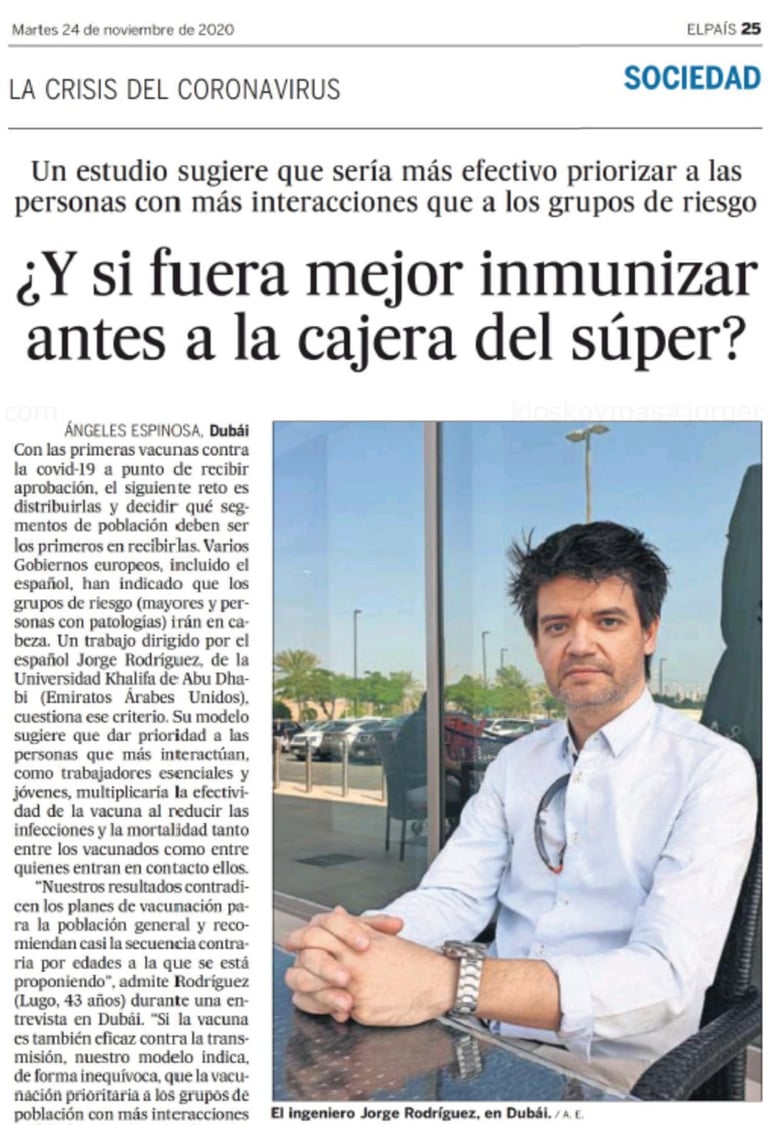
24 de noviembre de 2021 DIARIO EL PAIS
¿Y si fuera más útil vacunar primero a la cajera del supermercado?
Un trabajo académico dirigido por un ingeniero español sugiere que inmunizar antes a las personas con más interacciones sería más efectivo que priorizar a los grupos de riesgo.
ENGLISH VERSION
Should the supermarket cashier get vaccinated first against the coronavirus?
A new study suggests giving people with the most social interactions, and not at-risk groups, priority access to immunizations.